
If you are a beginner photographer, the world of photography may seem full of complicated concepts and technical terms. To help you understand the basics better, I have put together this quick guide explaining some of the most important photography terms.
ISO
ISO measures how sensitive your camera’s sensor is to light. The higher the ISO number, the more sensitive the sensor, which lets you shoot in lower light. However, raising ISO can cause more noise in the photo, which means the images will be less sharp and may contain more “grain”.
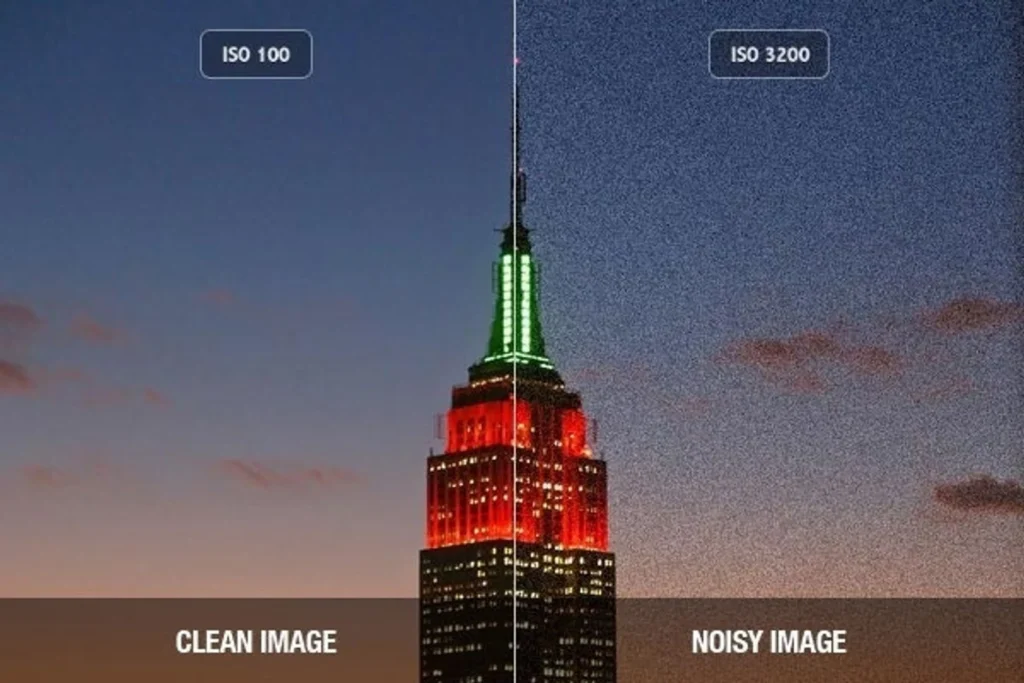
- In good lighting conditions, try to keep ISO low (for example ISO 100 or 200).
- In low light, raise ISO, but watch out for increased noise (for example ISO 800 or higher).
Aperture
The aperture is the opening in the lens that controls how much light reaches the camera’s sensor. It is expressed as an f-number (for example f/2.8, f/5.6). A smaller number (wider aperture) means more light and a shallower depth of field, so only a small part of the image will be sharp. A larger number (narrower aperture) means less light and a greater depth of field, so more of the image will be sharp.
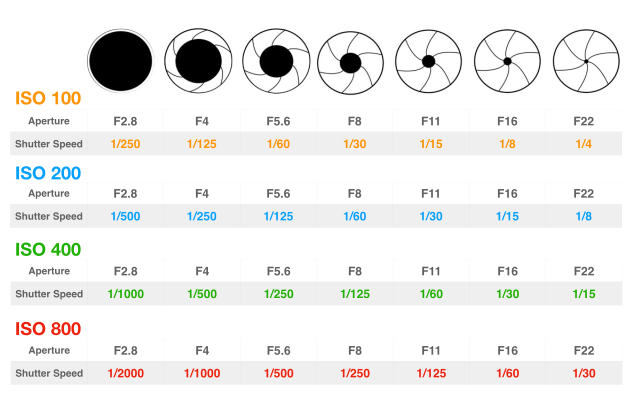
- For portraits, use a wide aperture (for example f/1.8 or f/2.8) to get a beautifully blurred background.
- For landscapes or group photos, use a narrower aperture (for example f/8 or f/11) to keep everything sharp.
Shutter speed
Shutter speed determines how long the camera’s sensor is exposed to light. It is expressed in seconds or fractions of a second (for example 1/500s, 1/30s). A shorter time (fast shutter speed) freezes motion, while a longer time (slow shutter speed) can create motion blur.
- When photographing fast-moving subjects (such as sports or animals), use a fast shutter speed (for example 1/1000s).
- When photographing the night sky or light trails, use a slow shutter speed (for example several seconds) and a tripod to capture the movement of light.
Focal length
Focal length is the distance between the optical centre of the lens and the sensor when the image is in focus. It is measured in millimetres (mm) and affects the angle of view and the magnification of the image. A shorter focal length (for example 18mm) gives a wider angle of view (wide-angle lens), while a longer focal length (for example 200mm) gives a narrower angle of view (telephoto lens).
- For landscapes and architecture, use a wide-angle lens (for example 18–35mm).
- For portraits or distant subjects, use a telephoto lens (for example 85mm or longer).
White balance
White balance affects how the camera interprets colours under different lighting conditions. Different light sources (sunlight, tungsten bulbs, neon lighting) have different colour temperatures, which can affect how colours look in the photo.
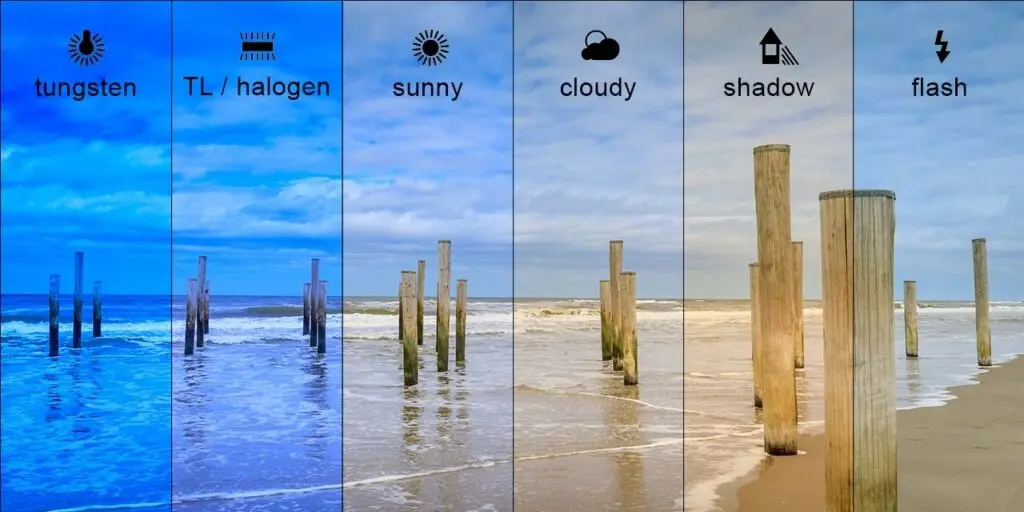
- Most cameras have an automatic white balance setting, which is usually good enough.
- In specific lighting conditions, try setting it manually to get more accurate colours (for example the “Tungsten” setting under incandescent light).
Exposure
Exposure is the total amount of light that reaches the sensor while you take a photo. It is affected by the combination of aperture, shutter speed and ISO. Correct exposure ensures your photos are neither too dark (underexposed) nor too bright (overexposed).
- Use the camera’s built-in light meter to get the right exposure.
- Try exposure bracketing, where you take several shots with different exposure settings and later choose the best one.
Conclusion
I hope this quick guide helps you better understand basic photography terms and improves your photography skills. Remember that practice makes perfect, so don’t hesitate to experiment and learn from your own experience!